|
|
Ottawa County Time Traveler Eastern Ottawa County Past & Present October 2024 |
|
by Linda Higgins Once upon a time in Port Clinton, Ohio, the red logo of the Standard Products Company could be seen on the silver water tower rising above the plant on Maple Street. The 250,000-square-foot plant was built in 1904 by a hardware manufacturing company, which sold it to a crayon manufacturer. By 1923, the building had also been used as a tire production facility. None of these companies became successful enterprises, so the plant stood empty until 1934.
James S. Reid, M.D., doctor-turned-inventor, developed what would become the company’s flexible window channel and weather strip for autos. He patented and manufactured it and an improved gas cap after having left the Cleveland Health Department. He purchased an interest in Standard Products in Cleveland, and continued development of these products.
The company was establishing itself quickly when Dr. Reid bought the empty Port Clinton plant in 1934. They focused on producing the channels and other rubber automobile items. In 1943 the company halted production for the automobile industry and began manufacturing 30-caliber carbines for the Army. Females were the majority working on these lines, all under “voluntary censorship” about their work. This secrecy ended after a short time and when the war ended, the company went back to producing the popular window channel. Losing war contracts affected the company’s bottom line briefly, but they quickly resumed prewar levels.
Standard Products continued to prosper and became prominent in manufacturing due to its innovations, its product-development capability, and top-of-the-line automated production processes. The U.S. government again contracted with the company, this time to produce rubberized tank track. It was one of three U.S. companies fully approved to do so. The Port Clinton division became the largest manufacturing division of the company. It produced the rubberized military tank track, rubber compounds for the other divisions of the company, structural glazing gaskets for the construction industry, and a line of molded and extruded products for automotive and industrial applications. The employees numbered between 300 and 500 much of the time, that number having risen to about 1,000 during the war.
Standard’s engineers and technicians collaborated with major automakers to design components for increasingly more sophisticated vehicles. Promotional materials stated that they were “part of every car on the road,” with Port Clinton’s division contributing greatly. And the company produced the rubber that was used in Houston’s Astrodome!
While the manufacturing boom of the ‘50s and ‘60s slowed in the ‘70s, the success of Port Clinton’s 20-acre division of The Standard Products Company continued through the ‘80s as a main contributor to the economic development of western Lake Erie. Its hundreds of employees added immeasurably to the financial base and quality of life in the city and the county. They participated in the local community’s organizations, civic, social, and religious. The company sponsored sports leagues within the company and the community, including Little League baseball, adding depth to the area’s growth.
The plant continued to do well, despite periodic layoffs, but it was the oldest of all the company’s buildings and needed considerable maintenance. The rapid introduction of new technology was a major factor in decisions to close manufacturing facilities throughout the country, as was the acquisition of potentially more efficient, lower-maintenance plants across the world. The Standard Products Company, Port Clinton Division, succumbed and was closed in 1993.
The plant remained empty and locked for twenty years. When serious concerns arose about contamination found on the site that might harm humans, the EPA conducted extensive testing. The test results proved the concerns unfounded. All affected areas, included the water tower, were cleared. An ongoing “voluntary action plan” was implemented and overseen by the agency. And the close-knit group of employees continued to gather regularly after the company closed, sharing memories of jobs they loved. The Standard Products Company, Port Clinton Division, truly had a good run! Use this link to see or share the article online: Linda |
|
On May 13, 1865, the Civil War officially ended.
After 40 months of operation, the prison camp on Johnson’s Island was closed. Over that time, it had seen an estimated 10,000 prisoners pass through. By Sept. 5, [1865] the island was free of Confederates. Johnson’s Island was now silent. No more roll call or the sounds of men’s voices. No more guns, soldiers, prisoners, or rat hunts. However, not all the prisoners returned to the South. At least one stayed on as a worker for early Danbury settler, Adam Kenne. His great-grandson, Bob Klinow had in his possession a chain of carved wooden links made from one piece of wood that the prisoner created. Maybe this man had nothing in the South to return to.
Most of the buildings were auctioned off, except for a few buildings outside the stockade. Some were towed on the ice to Marblehead and used for housing. The island returned to the possession of Leonard Johnson who started to farm it, planting corn and raising pigs. After Johnson’s death in 1898, others found use for the island.
In the early 1900’s, quarrying began on the island. Between 1902 and 1916, quarried limestone was sent to ports like Cleveland, Lorain, and Conneaut. At its peak, the quarry employed over 300 workers who were paid less than $2.00 a day. The island soon filled with housing for their families, a store, a U.S. Post Office, and school for their children from 1881-1917. The quarry forever changed the landscape of the island which was still only accessible by boat.
The only sign that a prison camp had existed on Johnson’s Island were the graves of the 206 men who died there. The cemetery was initially surrounded by a wire fence which was replaced by an Iron fence in 1890. Wooden grave markers were replaced with Georgian Marble markers, including 52 who to this day are labeled “unknown”. Funds for this upgrade were raised by a group of Georgia officials and newspaper editors. In 1904, the Daughters of the Confederacy purchased the 100’ x 485’ cemetery and in 1910 placed a bronze statue of a Confederate Private on a marble base facing Canada. It was titled “The Lookout” and was sculpted by Moses Ezekiel.
Many immigrant quarry workers lived in rude shacks on the island. One night in late March, after visiting a bar in Marblehead, an Italian worker Nichola Rocci and a friend were caught in a powerful wind and rain storm. They were afraid to return to the shacks for fear they would blow down, so they took refuge in the cemetery on the lee side of the Confederate Soldier Monument. Growing numb with cold, suddenly, they heard the sound of a bugle. The quarrymen jumped to their feet and were certain that felt the statue move! The bronze soldier turned on its axis so that it was now facing the dead Confederates. Next the hysterical workers heard clanking and rustling in the grass. They saw a body appear, then more. Men in gray uniforms with muskets on their shoulders rose from their graves. Slowly the phantom regiment marched across the cemetery and vanished from sight. When the storm let up, two days later, the quarry workers grabbed the first boat to Sandusky and never returned to Johnson’s Island.
Believe it or not.
You can use this link to read or share this article: Lorrie |
|
Haunted History Presentation @ Magruder Hospital Conference Center Thursday, November 7, 2024 6 pm Location: 615 Fulton St, Port Clinton, OH 43452 There's lots of haunted history to discover with presenter McKenna Essman, even after Halloween. Learn about local haunts in Northern Ohio. No registration required. |
|
Haunted Put-In-Bay by William G. Krejci Summarized from the back cover: Behind the beautiful scenery and wild nightlife is a side of Put-In-Bay that will make your hair stand on end. Reports of the ghost of assistant lighthouse keeper Sam Anderson, doors open and close as a spirit named Benny is said to toss things at the Brewery and Distillery, and the ghost of one of the island's most noted mayors is said to linger in the barroom of T&J's Smokehouse. Tour the dark aspects of island life with author William Krejci. 977.1212 KREJCI 2017 |
|
Halloween parties are not a new thing, and while kids have a good time with the holiday, adults were just as likely to put on costumes and go out to celebrate! |
|
Many genealogy resources are now online. And because all families are different, doing genealogies requires different resources depending on your specific family history. And you don't always know what resources you'll need until you actually start searching your family history. To get an idea of the breadth and depth of what is available, you can start with the genealogy page of the Ida Rupp Public Library, shown below. |
|
It has been over 30 years since the Ida Rupp Public Library has undergone renovation. To keep the library open through the months of this major project, work is being done in phases. The first phase is ending and materials have been moved into the updated space. Other areas that were open over the summer have now been closed off for their work under Phase 2. Here's a photo of work being done on an area for Phase 1. This will eventually become the YA area, but for Phase 2, it will temporarily hold the magazines, newspapers, and adult nonfiction titles. Stop in to see how it looks now. |
|
With Halloween just around the corner, even nature seems to be getting into the spirit of the macabre. Driving in Norwalk in late October, there were buzzards sunning themselves in the dead branches of a large tree. While buzzards are not typically found in northern Ohio this late in the year, it was fun to see them just hanging around like decorations for Halloween. 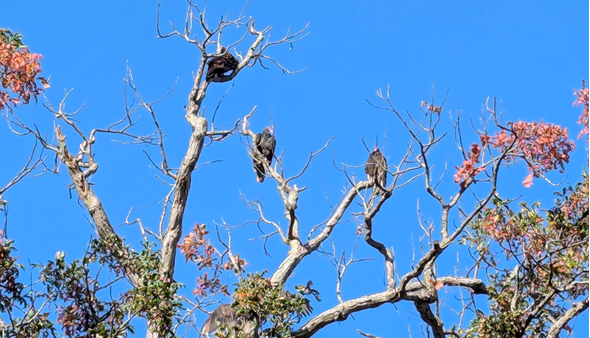 |
|
|
|
|
|