|
|
 |
|
December 2025 | |
|
 |
Adult Services Notes |
|
|
|
Refresh Your Find It VA Skills
December Sessions |
|
|
Access Video Just for Kids
Help your users find and enjoy great children's programs, including TV shows like Arthur, Sesame Street, Odd Squad, SciGirls, and much more. Access Video Just for Kids also offers read-along storybooks and learning videos to explore topics like reading, writing, math, arts and science.
When: Thursday 12/4, 1 PM ET
|
| Register |
|
|
State Resources to Know
December Sessions
|
|
|
The state of Virginia has a wealth of resources that librarians should be aware of, as they offer useful content and support when working with library patrons.
From financial information to small business to health and wellness to the arts, state agencies are there to help residents of the Commonwealth.
Many state agencies are also interested in collaborating with public libraries to better serve Virginians, offering programming opportunities and more. |
|
|
Department of Aging and Rehabilitative Services: No Wrong Door Initiative
The Virginia Easy Access website is your place to Search, Connect and Learn about services, programs and information in your area to support older adults, adults with disabilities, veterans and caregivers. The site offers tools and resources to easily find and connect with services and information, with an emphasis on each person’s unique needs which often span multiple life domains and social determinants of health.
Join Val Murphy and Sarah Arnold from VDARS to learn
-
How to use the main features, tools and resources available on the Virginia Easy Access website
-
How the 25 local Area Agencies on Aging (AAAs) are key partners providing services and building networks of resources
-
The goals and values of the No Wrong Door Virginia initiative
When: Tuesday, December 2, 1 pm ET |
| Register |
|
|
Virginia Open Data Portal
The Virginia Open Data Portal is the largest state Open Data Portal, hosting over 19,000 local, state, and federal datasets and it is constantly growing! Virginia librarians are encouraged to both utilize and share the platform with library patrons across the Commonwealth.
You will learn how to -
Navigate the Virginia Open Data Portal with confidence and efficiency
-
Search, filter, and access datasets across state agencies and programs
-
Create engaging story pages and data visualizations directly on the platform
-
Transform raw data into compelling narratives that inform and engage your audience" When: Tuesday, December 16, 1 pm ET |
| Register |
|
|
|
In case you missed these recent LVA trainings, here are the links to the recordings in Niche Academy:
|
|
|
State Resources to Know Series
|
|
Refreshing Your Find It VA Skills |
|
|
Niche Academy is open to all Virginia library staff members and library associates such as trustees and Friends board members. If you do not have a Niche Academy account, please use your library email address to sign up. If you do not have a library work email, you may register with a personal email, and we will contact you to confirm that you are affiliated with a Virginia library.
|
|
|
News from Library Development
|
|
|
|
Artificial Intelligence and Database Searching |
|
|
As we all know, artificial Intelligence (AI) is a hot topic, and like anyone else in the business world, database vendors are thinking about how AI will affect their work and exploring potentials that AI offers.
As information professionals, we need to be aware of how technology is changing in our profession as well as in society. While AI brings a host of challenges, our professional ethics require us to be able to talk about AI with our users, to share both the concerns and the advantages, and to enable them to make thoughtful, fact-based decisions about how they wish to use or not use AI. |
|
|
This is the first in a series of articles about how AI is being incorporated into the resources available to our users through the Find It Virginia collection.
These pieces will examine how our vendor partners are using AI, and what opportunities these uses offer to library staff and users alike, starting with EBSCO. |
|
|
EBSCO is incorporating AI to enable natural language searching (NLS) in the EBSCOhost databases, including those available in Find It VA.
In EBSCO's Explora tool, you can turn on the natural language search option just under the search bar. Doing so, will enable Explora's AI tool that converts a natural language search like "What are the impacts of climate change on Virginia" to a much more structured Boolean search, ((climate change OR global warming) AND (Virginia OR Virginia state) AND (impact OR effect OR consequence)), without the user having to know Boolean logic.
In this search example, the original search, without NLS turned on gave only three results, of which only one was slightly relevant. With NLS enabled, the search yielded 91 results with a much higher level of relevancy. Clicking the Show refined query link next to the natural language search button will display the actual Boolean query for the user, so there is also an educational process going on here.
For users new to research databases or who are not familiar with more advanced searching strategies, the natural language search option can be a valuable tool in their work. As users increasingly use tools like Co-Pilot, Gemeni, and ChatGPT for research, they are becoming used to simply putting in their query as a sentence. So offering this option in EBSCO's research tools makes sense, and enables even novice researchers to find the most relevant materials quickly.
With any AI tool, data integrity and privacy protection are crucial points, so it is important to note that the natural language tool "does not use user data for training. The data provided to the AI is based on the user's natural language query at the time of the search. No user information is stored during this process. The AI processes the query to enhance search results without retaining any personal data." (see EBSCO's AI Transparency Fact Sheet for more details).
To learn more about how EBSCO is working with AI, review the resources at AI at EBSCO. |
|
|
RUSA Online Training Reports |
|
|
In partnership with ALA's Reference and User Services Association, the Library Deveopment Division is delighted to offer training opportunities for Virginia library staff.
Scholarship recipients are asked to report out on key points or topics. Read the most recent report below. |
|
|
| Patron Response Framework: Responding with Kindness, Empathy, and Love in Difficult Situations
Rhonda Smith, Waynesboro Public Library
I’ve always been a person that cares about people. It comes within my heart and soul. The webinar was a reminder how difficult things can be in this world. People go through difficulties on a daily basis and we as transaction givers must have compassion, love, and humility.
We deal with certain situations, knowing that the patron could have just been told bad news from a doctor, family member, or dealing with a mental episode, etc. We have to be the one person, that show them a smile, be kind, have empathy and love. Making their lives better is so important, while knowing that we that we have helped someone along the way.
Here are some ways we can put this into practice:
-
Approach the situation with a positive demeanor, this will help set the mood and tone.
-
Listen to what has taken place, let the patron tell the story.
-
Be patient, considerate, and friendly; keep an open mind.
-
Evaluate what has happened, try to come to a fair, reasonable conclusion.
-
Try to put yourself in their shoes, being able to relate to the patron.
-
Thank the patron for letting you know.
-
Explain to them that if more is needed that you will reach back out to them. |
|
|
| Understanding Emotional Intelligence
Emily Elswick, Lonesome Pine Regional Library
Two lifelong pursuits shape our personal and professional lives: learning and human connection. The opportunity to learn about how to interact with my fellow humans came via news that the LVA/RUSA was offering an elearning scholarship. Already taking full-time courses towards my associates degree, I was a little apprehensive about taking on another class. My love for learning outweighed the extra stress on my schedule. After looking over what classes were offered, I knew that the “Understanding Emotional Intelligence” course was one that I didn’t want to miss out on. At any job I have worked one thing that has been consistent is socializing with both coworkers and patrons. With a background in healthcare and the service industry I am no stranger to dealing with, at times, very highly emotional situations. Besides light work training up to this point I had really been winging most of my EI (emotional intelligence) skills. In fact I did not even know there was such a term beforehand. Excitement started to build after reading the course expectations by Debra Lucas-Alfieri to learn about this world that felt vaguely familiar yet intriguingly foreign.
Unless someone finds the perfect secluded island that's self-sustainable they at some point or another will need to talk to, work with, or at times rely on, another person. Think about going to the grocery store, even before exiting the vehicle you might use EI. Allowing someone to cross the street or waiting on them to back out before driving ahead demonstrates the four pillars:
-
Self-Awareness: Understanding one's own emotions and the way your behavior and interactions affect others.
-
Self-Management: Controlling your own emotional reactions and impulses.
-
Social Awareness: Understanding and acknowledging the emotions and behaviors of others (relationship management).
-
Relationship Management: Using your awareness of your own emotions and those of others in interactions successfully.
Being aware that we individually have our own emotions that can influence what we do or say is not only a good relationship management skill, but a wonderful way to practice how to recognise those feelings in others. Maybe someone feels rushed at the store and wants to hurry real quick to get a parking spot. If they allow haste to rule their actions, it’s possible someone is going to get hurt. Or at the least cut off abruptly. That’s when self-management comes in! We often forget that others have emotional landscapes as rich as our own, mindfulness aids in not letting those feelings get the best of us.
The fourth domain of EI, known as relationship management utilizes those tools learned from the other three to aid in effective dispute settlement.
Solving conflict between each other is one thing, but doing so in a way that both parties feel seen, heard, and acknowledged can be tricky. Getting your own point across without the awareness of relationship management can at times seem harsh. Like speeding through a crosswalk past a pedestrian because there's that one perfect parking spot. When applying EI strategically, resolving disputes with empathy ensures both parties feel heard—transforming tension into opportunity.
Possessing empathy aids in the visualization of another human's goals and wants. Allowing ourselves to shift our perspective on a collaborative task can help reveal solutions we might not have seen previously. This approach can influence how others see you going forward therefore having long-term impact on the connection between the parties. The management of relations is important everywhere, but especially when it comes to teamwork.
One key focus of the course was how libraries can foster emotionally intelligent workplaces. Combining soft and technical skills improves teamwork, office dynamics, and morale. Managers and leaders play a crucial role in setting the emotional tone. With EI, they can create environments where individuals and teams thrive.
Does this mean everyone needs to be relentlessly positive, cheery, and outgoing when navigating these relationships? Not at all. Daniel Goleman, whose work was referred to often throughout our class, believes those are reflections of EI competencies. This means that with proper training people can learn the ability to acknowledge and regulate emotions in ourselves and in others. Taking time to learn these pillars and using them properly has immense benefits to both one's professional and private life. Learning EI can benefit anyone, from the top earning CEO to the regular old Joe schmo on the street. |
|
|
Next year will mark America’s commemoration of the 250th anniversary of our nation’s founding. The Library of Virginia has compiled some of our favorite primary source documents from our collections to help teach students about the American Revolution. Get started on our Teach VA250 page.
|
|
|
Readers' Advisory Tips and Tricks
|
|
|
VA Library Staff Favorite Adult Books of 2025 |
|
|
December is a great time for making lists, and for the past few years, LVA has collected favorite books of the year for adult readers from library staff around the state and shared the lists in the new year.
If you would like to share your favorite books of 2025 (limit of three), use the button below to go to the survey collector and enter your titles. |
|
|
These can be new titles or old, fiction or nonfiction. The only requirement is that they were titles that sparked joy for you!
We will share the compiled fiction and nonfiction lists in January. |
|
|
|
|
Digital Pathways: Online Health Literacy Programming for Adults |
|
|
From providing accurate and authoritative health information resources to making telehealth possible with reliable broadband access and privacy pods, libraries have been and continue to be an important part of the effort to create healthy communities.
In support of this work, ALA has developed a toolkit that includes tools and resources "focused on effectively creating online health literacy programming for adults." |
|
|
According to the Digital Pathways announcement, "In collaboration with UnitedHealthcare, the ALA Public Programs Office is launching an exciting pilot program to implement this toolkit. Over a nine-month period, 12 public libraries will be selected to receive a resource package and hands-on support to strengthen their online health literacy offerings. Participating libraries will use the toolkit to host at least three adult health literacy programs in their communities and will play a key role in shaping the future of this initiative by sharing feedback with project evaluators."
Applications are open through January 7, 2026. |
|
|
|
|
|
Looking for a new program to reach your older adult users in the new year? Chair-based exercise programs can be a great way to connect with your older users, make connections, and build a healthier community.
Programs like this are also opportunities to partner with local community centers, exercise businesses, and senior organizations. |
|
|
Let's Move in Libraries, which "focuses on supporting healthy living in public libraries" has a great toolkit for getting started with chair-based exercise programs at the library, including potential costs, things to consider, marketing ideas, and more.
So get your older community moving in the library in 2026! |
|
|
|
Featured Virginia Programs
|
|
|
Pamunkey Regional Library
|
|
|
|
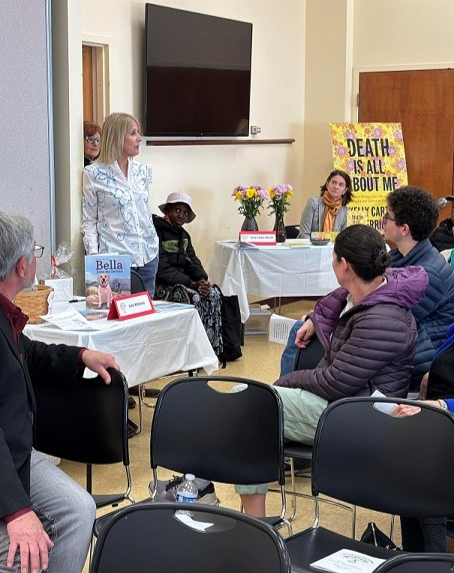
In April 2025, the Ashland Branch of Pamunkey Regional Library and the Friends of the Ashland Library hosted the Ashland Author Festival, an event designed to celebrate and shine a spotlight on the many talented authors who call Ashland home.
Writers representing a variety of genres, including history, memoir, sustainable living, and children's literature were represented. Following remarks by the mayor of Ashland, authors were given the opportunity to share anecdotes about their writing journeys and insights into their respective crafts. Afterward, attendees enjoyed meeting and mingling with Ashland's authors and checking out their latest works. |
|
|
Published works by all of the authors who attended the festival are available to readers through the Pamunkey Regional Library. Several authors have presented programs at the Ashland Library in the past and some are a part of the Ashland Branch's writing group. All authors appreciated the opportunity to meet other authors in Ashland and to share their love of writing with the public.
|
|
|
For more info, contact Joanne Jones, jjones@pamunkeylibrary.org
|
|
|
|
|
Recent articles on topics of interest to Adult Services |
|
|
|
This newsletter is made possible by a grant from the U.S. Institute of Museum and Library Services. It is published by the Library of Virginia Library Development Division.
|
|
|
|
|